Saturday, January 24, 2009
PACMAC
So today I got to help Sean do a demo at the 3rd Annual Pacific Martial Arts Conference in Eugene. Like last year, it was fun! We used some real cheap pseudo-wasters to show 60 odd martial artists from various systems and styles some basic grappling actions from the Spada in Armi sections of the Fiore manuscripts. We used the "new" fiddle-bow-esque posta from the Florius (which we have named "Posta di entrare" - Guard of Entering). The first action we did was a simple serpentine on the sword and take-away against a thrust. Then we used the same basic action, but entering deeper and wrapping the left arm in a ligadura sottana. We had planned on doing a collar-throw and reversal from the Bolognese pollaxe material, but we ran out of time :( All in all it was a great day, at least what I got to experience before I had to run off to work. I think my highlight was Sensei Best of Best Martial Arts in Eugene talking about how the basic karate punch (and it's action) can be used as a high and low block, much like every strike with sword can be a parry as well as a strike. All in all, it was great to network with the areas other martial artists and spend a day (or part of one anyways) realizing that we all do the same stuff, just differently.


Wednesday, January 21, 2009
So, as an aside to what I normally write about here, I am a big MMA fan. As a sport it is very impressive. By far, my favorite fighter is Fedor Emelianenko. If you know who he is, or if you have no clue, just watch these 6 mini-episodes about him. He is not only a great fighter he truly is a wonderful and well-rounded man.
http://www.youtube.com/user/DirtyFedor
http://www.youtube.com/user/DirtyFedor
Wednesday, January 14, 2009
Updates
So by far the single most frustrating thing about living in Eugene with all its rain is that the grass is permanently soggy. This, combined with living in an apartment, means that I only have two choices for sword/axe training: 1) Drive across town to the salle or 2) Practice in the middle of the complex's driveways. I know that deep down it is my own laziness that keeps me from actually grabbing the weapons and doing it, but sadly in this age you have to be careful about practicing our arts outside. I have already had police called on me by my neighbors for practicing in my old yard with my aluminum sword, so I can only imagine how quickly the cops will be called if I break out my pollaxe in the driveway! So I will just do what I have been doing for a while, which is going to the salle about an hour before class and spending my time at home doing the mental side of WMA training (especially trying to learn French).
On the positive side, owning all six seasons of Mythbusters is awesome!
On the positive side, owning all six seasons of Mythbusters is awesome!
Tuesday, December 23, 2008
What a fun weekend!
So this was a fun weekend. Between our water heater nozzle breaking off and spewing 15 gallons all over our floor, which then had to vacuumed up (Thanks Chris and E!) and working at the mall during Christmas, it has been ridiculous. By the way, in case you've ever wondered, hand vacuuming a floor with a 15 gallon Shop-Vac is an awesome back workout!
What was awesome is that last night (Monday the 22nd) I got to teach an "Intro-to-Pollaxe" class at the Academy. It was the first time I've been able to teach pollaxe material by myself and I based the night on my interpretation of Le Jeu de la Hache. What is great about teaching WMA is that it allows you to see if your interpretations really hold up and whether they are easy for others to learn too. There were only three folks there last night, but two of them had never handled an axe before, so it was good to see if my "basic axe training" actually works! It also was one of the first times I had been able to play with the axe in my kit (breastplate, arms and helm). The only change I wanted to make because of the armour was the realization that I need a better gambeson/arming cotte. The debate is now to go historical (expensive) or psuedo-historical (potentially cheaper).
At the end of the night, I wanted to change a few specifics about the plays I chose, but I had learned a lot about axe-fighting as well. In my opinion, axe play isn't as subtle or "elegant" as sword-play (because of the limitations imposed by armour and polearms in general), but it's beauty is in it's very straight-forward system of play. After all, there is a reason Fiore describes the axe as "ponderous, cruel and mortal"
What was awesome is that last night (Monday the 22nd) I got to teach an "Intro-to-Pollaxe" class at the Academy. It was the first time I've been able to teach pollaxe material by myself and I based the night on my interpretation of Le Jeu de la Hache. What is great about teaching WMA is that it allows you to see if your interpretations really hold up and whether they are easy for others to learn too. There were only three folks there last night, but two of them had never handled an axe before, so it was good to see if my "basic axe training" actually works! It also was one of the first times I had been able to play with the axe in my kit (breastplate, arms and helm). The only change I wanted to make because of the armour was the realization that I need a better gambeson/arming cotte. The debate is now to go historical (expensive) or psuedo-historical (potentially cheaper).
At the end of the night, I wanted to change a few specifics about the plays I chose, but I had learned a lot about axe-fighting as well. In my opinion, axe play isn't as subtle or "elegant" as sword-play (because of the limitations imposed by armour and polearms in general), but it's beauty is in it's very straight-forward system of play. After all, there is a reason Fiore describes the axe as "ponderous, cruel and mortal"
Saturday, November 29, 2008
Turkey Day!!!
So Kim and I had our first Thanksgiving together. It was awesome! We had her parents and her brother and his fiance over, and we got to cook our first turkey. All together, we made the turkey, stuffing, succotash, green-bean casserole and the gravy. Well, to be honest, Kim made all this and I just watched and chopped stuff. All in all, it was a successful turkey day and I am extremely proud of Kim for putting all of it together, especially with us both being sick! Now I get to look forward to years of leftovers! Haha!
Saturday, November 22, 2008
The Development of the Pollaxe
The pollaxe represents one of the best innovations of the “medieval arms race”, as it were. The increasing use of the more protective plate armour, in concordance with maille, leather, and cloth armours, meant that specialized weapons had to be developed, or more commonly old weapons had to be updated and improved upon, to defeat these armours. The pollaxe, the combination of axe, spear, and hammer, is an ideal weapon to deal with both armoured and unarmoured foes, at either long or close range. I lay out here my suppositions for the development of the axe, as well as potential reasons for the variety of shapes in historical examples, based on my experience as a medieval historian and a practitioner of Historical European Martial Arts.
To first understand the development of the pollaxe it is necessary to look at the etymology of the three most common ways of spelling the word itself: poleaxe, pollaxe, and polaxe. All three spellings can be broken down into two parts; the prefix and the word “axe”. Because it is common to all three, we will look at the word “axe” first. The Merriam-Webster Dictionary defines the word as “ax or axe: a chopping or cutting tool with an edged head fitted parallel to a handle”. I believe it is safe to assume that most of us are familiar with this kind of tool, and from it’s presence we can infer that the weapon will be some kind of axe, or have some kind of axe-head on it. So now we look at the three options we have for a prefix and from them we can try to piece together what this weapon looks like and how it was developed. The word “pole” is defined as “a long slender piece of wood or metal” (Miriam-Webster). Then the word “poleaxe” quite literally means “an axe on a (long) pole”. The next option, “poll”, is defined in the Merriam-Webster Dictionary first as “head”, and that makes sense when you consider modern use of the word (“to take a poll”, “the poll’s show”) where it denotes a vote, or a head-count. So, the word “pollaxe” simply means “axe-headed”. As for the third option, “pol” comes from Greek indicating “society” or “person” and is, in my opinion, a precursor to the word “poll” and can be interpreted in the same manner. By combining these definitions, we have a weapon that has an axe-head, mounted on a long pole. We can reasonably assume then that the pollaxe is derived from the axe.
The simple axe was one of mankind’s first tools, being a stone knife tied to a stick. It has continued to be a common tool in most cultures, right up to the modern period. As far as its use as a weapon of war, both the single-handed and two-handed variants can deliver powerful blows and are usually ready-at-hand, being used as a tool for chopping wood. Unlike a sword, which exists only as a weapon of war, the axe would be used all the time for chopping wood, building dwellings, etc. and would be familiar in the hand. Because it is familiar to you, then when you have to fight you will go with what is familiar. Arguably, the axe is also cheaper to produce than a sword and wood hafts are easily replaceable. The main problem with the axe as a weapon (and from here on I will mainly be discussing the two-handed axe as that is what closely pertains to the development of the pollaxe), however, is that the base version is rather one dimensional in that it lacks the capability to do more than chop or cut effectively. Notice I used the word, “effectively”. One problem with two-handed axes is that while the long hafts allow for strong blows, the axe is not capable of delivering thrusts. Not only are thrusts useful for finding the gaps in plate armour, or penetrating maille, leather or cloth, but they also serve to extend the distance between combatants. For this reason, the top fluke of the axe head began to be elongated and reinforced, like this Hungarian axe or the Russian berdysh, making the weapon a combination of spear and axe, the ideal combination to deal with foes armed in maille, leather and cloth and transforming the axe from a simple farm tool into a weapon of war.
The axe as a weapon was used by all classes of combatants, including the nobility. As plate became more prevalent, the nobility needed a weapon for foot combat that was capable of delivering cuts to un-armoured parts of the body, thrusts to the gaps in armour (strong enough to penetrate maille, leather or cloth), as well as being able to deliver crushing blows, especially to the joints. Because of the limited visibility allowed in bascinet helms with visors, the weapon needed to be useful no matter how it was picked up. That and the need to have a counter-balance for the axe blade, lead to a hammer being placed opposite the axe blade on the head of the weapon. As the pollaxe became more prevalent variants began to appear. The two most common types were the axe/hammer type and the hammer/fluke type. A third variant was an axe/fluke type. All pollaxes have a spike on the top of the haft and some have a spike on the bottom end as well. It is the hammer/fluke variant that is shown most often in manuscripts, both German and Italian, and is the type described in the Burgundian “Le Jeu de la Hache”, the only manuscript to deal exclusively with the pollaxe. But no matter the composition of the head of the weapon, all are referred to as an axe; “l’azza” in Fiore and Vadi, “le hache” in Le Jeu, and “der axst” in Talhoffer (Anglo, “Le Jeu de la Hache”).
It is intriguing that while the axe/hammer variant seems to be more prevalent both in surviving examples and contemporary artwork; it is the hammer/fluke type that is shown/described in manuscripts. The reasons for this are varied and likely lost to history, but my personal conjecture is that both variants, as well as the earlier forms of the two-handed axe, were used together, the decision to use one or the other likely dependent on personal choice. I do view the polehammer variant as the more specialized tool for judicial duels when dealing with opponents in full harness, much as Fiore and Vadi show swords that were specific to judicial dueling. The pollaxe was perhaps better suited to the battlefield, where the axe blade could be used to great affect against more lightly armoured foes (I am not entirely convinced by this myself, but I have yet to hear any better theories).
Concluding points:
• The pollaxe developed from the simple two-handed axe because of a need to combine the axe with the range capabilities of the spear and the crushing capabilities of the mace/hammer.
• The pollaxe is a specialized weapon developed for use against armoured opponents.
To first understand the development of the pollaxe it is necessary to look at the etymology of the three most common ways of spelling the word itself: poleaxe, pollaxe, and polaxe. All three spellings can be broken down into two parts; the prefix and the word “axe”. Because it is common to all three, we will look at the word “axe” first. The Merriam-Webster Dictionary defines the word as “ax or axe: a chopping or cutting tool with an edged head fitted parallel to a handle”. I believe it is safe to assume that most of us are familiar with this kind of tool, and from it’s presence we can infer that the weapon will be some kind of axe, or have some kind of axe-head on it. So now we look at the three options we have for a prefix and from them we can try to piece together what this weapon looks like and how it was developed. The word “pole” is defined as “a long slender piece of wood or metal” (Miriam-Webster). Then the word “poleaxe” quite literally means “an axe on a (long) pole”. The next option, “poll”, is defined in the Merriam-Webster Dictionary first as “head”, and that makes sense when you consider modern use of the word (“to take a poll”, “the poll’s show”) where it denotes a vote, or a head-count. So, the word “pollaxe” simply means “axe-headed”. As for the third option, “pol” comes from Greek indicating “society” or “person” and is, in my opinion, a precursor to the word “poll” and can be interpreted in the same manner. By combining these definitions, we have a weapon that has an axe-head, mounted on a long pole. We can reasonably assume then that the pollaxe is derived from the axe.
The simple axe was one of mankind’s first tools, being a stone knife tied to a stick. It has continued to be a common tool in most cultures, right up to the modern period. As far as its use as a weapon of war, both the single-handed and two-handed variants can deliver powerful blows and are usually ready-at-hand, being used as a tool for chopping wood. Unlike a sword, which exists only as a weapon of war, the axe would be used all the time for chopping wood, building dwellings, etc. and would be familiar in the hand. Because it is familiar to you, then when you have to fight you will go with what is familiar. Arguably, the axe is also cheaper to produce than a sword and wood hafts are easily replaceable. The main problem with the axe as a weapon (and from here on I will mainly be discussing the two-handed axe as that is what closely pertains to the development of the pollaxe), however, is that the base version is rather one dimensional in that it lacks the capability to do more than chop or cut effectively. Notice I used the word, “effectively”. One problem with two-handed axes is that while the long hafts allow for strong blows, the axe is not capable of delivering thrusts. Not only are thrusts useful for finding the gaps in plate armour, or penetrating maille, leather or cloth, but they also serve to extend the distance between combatants. For this reason, the top fluke of the axe head began to be elongated and reinforced, like this Hungarian axe or the Russian berdysh, making the weapon a combination of spear and axe, the ideal combination to deal with foes armed in maille, leather and cloth and transforming the axe from a simple farm tool into a weapon of war.
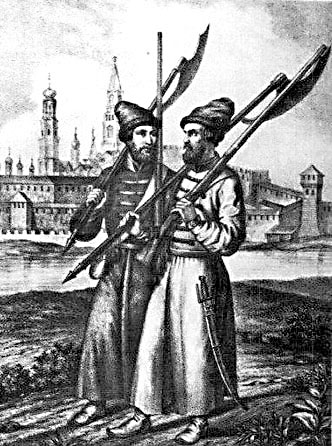
The axe as a weapon was used by all classes of combatants, including the nobility. As plate became more prevalent, the nobility needed a weapon for foot combat that was capable of delivering cuts to un-armoured parts of the body, thrusts to the gaps in armour (strong enough to penetrate maille, leather or cloth), as well as being able to deliver crushing blows, especially to the joints. Because of the limited visibility allowed in bascinet helms with visors, the weapon needed to be useful no matter how it was picked up. That and the need to have a counter-balance for the axe blade, lead to a hammer being placed opposite the axe blade on the head of the weapon. As the pollaxe became more prevalent variants began to appear. The two most common types were the axe/hammer type and the hammer/fluke type. A third variant was an axe/fluke type. All pollaxes have a spike on the top of the haft and some have a spike on the bottom end as well. It is the hammer/fluke variant that is shown most often in manuscripts, both German and Italian, and is the type described in the Burgundian “Le Jeu de la Hache”, the only manuscript to deal exclusively with the pollaxe. But no matter the composition of the head of the weapon, all are referred to as an axe; “l’azza” in Fiore and Vadi, “le hache” in Le Jeu, and “der axst” in Talhoffer (Anglo, “Le Jeu de la Hache”).
It is intriguing that while the axe/hammer variant seems to be more prevalent both in surviving examples and contemporary artwork; it is the hammer/fluke type that is shown/described in manuscripts. The reasons for this are varied and likely lost to history, but my personal conjecture is that both variants, as well as the earlier forms of the two-handed axe, were used together, the decision to use one or the other likely dependent on personal choice. I do view the polehammer variant as the more specialized tool for judicial duels when dealing with opponents in full harness, much as Fiore and Vadi show swords that were specific to judicial dueling. The pollaxe was perhaps better suited to the battlefield, where the axe blade could be used to great affect against more lightly armoured foes (I am not entirely convinced by this myself, but I have yet to hear any better theories).
Concluding points:
• The pollaxe developed from the simple two-handed axe because of a need to combine the axe with the range capabilities of the spear and the crushing capabilities of the mace/hammer.
• The pollaxe is a specialized weapon developed for use against armoured opponents.
Wednesday, November 12, 2008
I know....
I suck at this whole "blog" thing. Anyways, tonight at the academy (Northwest Fencing Academy) we worked on the "spada in armi" portions of the four Fiore manuscripts. Especially on our minds is the "new" Florius manuscript and it's weird armoured position with the sword held in the crook of the arm, not in the hand. Anyways, afterwards we took some pictures and here I am in my harness so far (well, I borrowed the gauntlets...).

The Guard of the Queue from Le Jeu de la Hache

The Guard of the Croix from Le Jeu de la Hache

Simply standing ready.

Heroic pose (Thanks Mike).
"So I got one question for ya ounk, do you feel lucky? Well, do ya?"

The Guard of the Queue from Le Jeu de la Hache

The Guard of the Croix from Le Jeu de la Hache

Simply standing ready.

Heroic pose (Thanks Mike).
"So I got one question for ya ounk, do you feel lucky? Well, do ya?"
Subscribe to:
Posts (Atom)